Although NBA players are "locked out," the great ones always use the time off to find ways to improve.
Monday, September 12, 2011
Saturday, September 10, 2011
Our "Nail" Offense was originated by Dean Smith, North Carolina's legendary coach. Coach Smith called this offense: "4 Corners" or "4 to Score."
The purpose of "Nail" is to SPREAD the defense and SCORE open lay-ups and free throws. Like Coach Smith's Tarheels, the NRP Knights have enjoyed a very HIGH SUCCESS RATIO when "Nail" is employed. Coach Smith's "4 Corners" was such a potent offensive weapon that the NCAA adopted the shot clock in order to stop him from using it. Over one six-year period, the Tarheels amassed an amazing 105-2 record whenever they went to the "4 Corners." Opposing defenses surely couldn't stop the Tarheels' "4 Corners" ... any wonder why college basketball adopted the shot clock?

Tuesday, August 30, 2011
Shooters: Lead with your shooting shoulder (Part 1)

 For years we have taught the importance of a shooter "leading with his shooting shoulder."
Leading with the shooting shoulder NATURALLY turns the body in the direction of the shooter's guide hand (as seen in the adjacent pictures of MJ and Kobe.)
In addition, we emphasize the role of the feet in terms of bringing the body to a complete stop, under control--but, not "squaring the feet" per se.
A slight turn of the body as the shooter "leads" with his shooting shoulder is most clearly observed with good free throw shooters because the stationary nature of the free throw allows the shoulder lean to be clearly seen.
I was first introduced to this concept by observing closely one of my all-time favorites, former Bulls' forward Bob "Butterbean" Love.
Wednesday, February 2, 2011
Always Ready! Next Man In!

Doug Legursky, a second-year undrafted back-up center for the Pittsburgh Steelers is the focus of Super Bowl media coverage for the past two weeks. Legursky might be pressed into the starting role in the Super Bowl if the Steelers' regular center Maurkice Pouncey is unable to play due to a high ankle injury.
Quotes from Legursky:
Asked by a group of reporters if he was nervous about possibly starting in the Super Bowl, Legursky said: "I'm more nervous talking out here to you guys ..." He added: "I come to the stadium prepared to start every game, even when I don't. It's about being a student of the game. I think it's just preparation and hard work ... it's about being in sync with Ben (Roethlisberger) ... I am always working in the lab and if that opportunity comes, I'm ready."
TALK ABOUT A GUY WHO UNDERSTANDS HOW TO MENTALLY PREPARE. HE IS ALWAYS READY. EACH GAME -- THE ENTIRE SEASON -- WAS LIKE THE SUPER BOWL FOR HIM. IF POUNCEY CAN'T GO ON SUNDAY, LEGURSKY WILL BE READY -- THE SUPER BOWL IS JUST ANOTHER GAME FOR HIM!!!!
Sunday, January 23, 2011
Coach Tomlin Speaks
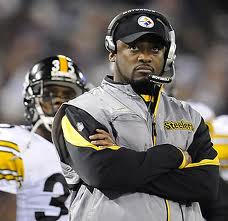 With tonight's victory over the Jets, Pittsburgh Steelers coach Mike Tomlin leads his team to their second Super Bowl in 3 years. Tomlin is the first head coach in NFL history under the age of 40 to lead a team to two Super Bowls. At age 36, he
was the youngest head coach ever to win a Super Bowl when the Steelers won it all in 2008. In addition, his Steelers have now won 3 AFC North Championships in the past 4 years.
Coach Tomlin was a standout football student-athlete at the prestigious College of William and Mary. He shares his thoughts on attaining championship level performance:
"You've got to be good at mastering the core football values. Playing hard. Playing fast. Living in and feeling the urgency of now. I think that's what good teams do. These are some of the things that would be important to me."
When asked about beating the Ravens three times in one season in 2008-2009 season: "I personally don't subscribe to that hocus-pocus. What happened in the other games will have no bearing on the outcome of this game. Each individual performance stands on its own. We're not buying into that."
"In order to be a candidate for a championship caliber team you have to work hard, but within that we have to find a delicate balance of working smart."
"We don't live in our fears, we live in our hopes."
"I tend to attack the challenges that are right in front of me, the ones that I have today."
"Be where you're at."
Friday, January 21, 2011
The great Bill Russell, Boston Celtics


"My pride was being part of a team."
Bill Russell after winning his 11th NBA Championship in 1968
Friday, January 14, 2011
Sunday, January 9, 2011
Athletes' Choices Can Help or Hinder the Development of Confidence
 "Confidence is a factor that can influence an athlete’s performance in remarkable ways. It can cause the cocky to make tactical and strategic errors. The lack of it can mess with the performance of talented athletes because they fail to channel their focus in the most effective manner – or worse – they give less than their best in the effort….because it won’t matter anyway. There are many choices each athlete must make from the very beginning of their season throughout each and every competition. These choices can make a pivotal difference in who succeeds and who doesn’t." Dr. Stephen Walker
Many athletes have an “outside-in” orientation and base their confidence largely on external sources that are inconsistent or out of their control. Some of these "external" factors are: having recent success, a good week of practice, having a great warm-up, liked their lane assignment, liked the site of competition, the weather was in their favor, played well here the year before, or they received a positive comment from their coach. All of these factors are "external" sources of confidence, in which the athlete has little or no control.
If an athlete’s confidence is based on "internal" factors, it is possible for him to feel confident despite any unfavorable external factors. There are five main components to developing "internal" confidence:
1. Belief in Method -- Know that your training method is the best one for you and work hard at your training method.
2. Positive Self-Talk -- Remind yourself of your strengths and successful past performances.
3. Positive Visualization -- Mentally practice good execution and successful performance in advance of competition.
4. Trust -- This is the opposite of doubt, worry, and fear. Know that your ability, preparation, and strategies which you have practiced and visualized will yield positive results.
5. Mapmaking -- Set specific, clear, and measurable goals of what you would like to accomplish.
The central theme to each of these elements is the athletes’ will to choose.
Friday, December 31, 2010
880! Coach K Makes History
 Earlier this week with a win over UNCG, Duke's Coach K moved into second place on college basketball's all-time win list.
Coach K's career win 880 eclipses Dean Smith at 879 and puts the Duke coach 22 wins behind the all-time leader, Bob Knight.
Here are a few team-building nuggets from Coach K:
“Effective teamwork begins and ends with communication.”
“Communication does not always occur naturally, even among a tight-knit group of individuals. Communication must be taught and practiced in order to bring everyone together as one.”
“When you are passionate, you always have your destination in sight and you are not distracted by obstacles. Because you love what you are pursuing, things like rejection and setbacks will not hinder you in your pursuit. You believe that nothing can stop you!”
“Mutual commitment helps overcome the fear of failure—especially when people are part of a team sharing and achieving goals. It also sets the stage for open dialogue and honest conversation.”
“When a leader takes responsibility for his own actions and mistakes, he not only sets a good example, he shows a healthy respect for people on his team.”
“There are five fundamental qualities that make every team great: communication, trust, collective responsibility, caring and pride. I like to think of each as a separate finger on the fist. Any one individually is important. But all of them together are unbeatable.”
“You develop a team to achieve what one person cannot accomplish alone. All of us alone are weaker, by far, than if all of us are together.”
“Confidence shared is better than confidence only in yourself.”
Subscribe to:
Posts (Atom)