Sunday, January 23, 2011

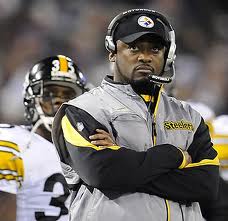
Coach Tomlin Speaks

With tonight's victory over the Jets, Pittsburgh Steelers coach Mike Tomlin leads his team to their second Super Bowl in 3 years. Tomlin is the first head coach in NFL history under the age of 40 to lead a team to two Super Bowls. At age 36, he
was the youngest head coach ever to win a Super Bowl when the Steelers won it all in 2008. In addition, his Steelers have now won 3 AFC North Championships in the past 4 years.

Coach Tomlin was a standout football student-athlete at the prestigious College of William and Mary. He shares his thoughts on attaining championship level performance:

"You've got to be good at mastering the core football values. Playing hard. Playing fast. Living in and feeling the urgency of now. I think that's what good teams do. These are some of the things that would be important to me."

When asked about beating the Ravens three times in one season in 2008-2009 season: "I personally don't subscribe to that hocus-pocus. What happened in the other games will have no bearing on the outcome of this game. Each individual performance stands on its own. We're not buying into that."

"In order to be a candidate for a championship caliber team you have to work hard, but within that we have to find a delicate balance of working smart."

"We don't live in our fears, we live in our hopes."

"I tend to attack the challenges that are right in front of me, the ones that I have today."

"Be where you're at."

Friday, January 21, 2011

The great Bill Russell, Boston Celtics


"My pride was being part of a team."
Bill Russell after winning his 11th NBA Championship in 1968

Friday, January 14, 2011

Sunday, January 9, 2011

Athletes' Choices Can Help or Hinder the Development of Confidence

"Confidence is a factor that can influence an athlete’s performance in remarkable ways. It can cause the cocky to make tactical and strategic errors. The lack of it can mess with the performance of talented athletes because they fail to channel their focus in the most effective manner – or worse – they give less than their best in the effort….because it won’t matter anyway. There are many choices each athlete must make from the very beginning of their season throughout each and every competition. These choices can make a pivotal difference in who succeeds and who doesn’t." Dr. Stephen Walker

Many athletes have an “outside-in” orientation and base their confidence largely on external sources that are inconsistent or out of their control. Some of these "external" factors are: having recent success, a good week of practice, having a great warm-up, liked their lane assignment, liked the site of competition, the weather was in their favor, played well here the year before, or they received a positive comment from their coach. All of these factors are "external" sources of confidence, in which the athlete has little or no control.

If an athlete’s confidence is based on "internal" factors, it is possible for him to feel confident despite any unfavorable external factors. There are five main components to developing "internal" confidence:

1. Belief in Method -- Know that your training method is the best one for you and work hard at your training method.

2. Positive Self-Talk -- Remind yourself of your strengths and successful past performances.

3. Positive Visualization -- Mentally practice good execution and successful performance in advance of competition.

4. Trust -- This is the opposite of doubt, worry, and fear. Know that your ability, preparation, and strategies which you have practiced and visualized will yield positive results.

5. Mapmaking -- Set specific, clear, and measurable goals of what you would like to accomplish.

The central theme to each of these elements is the athletes’ will to choose.

Friday, December 31, 2010

880! Coach K Makes History

Earlier this week with a win over UNCG, Duke's Coach K moved into second place on college basketball's all-time win list.

Coach K's career win 880 eclipses Dean Smith at 879 and puts the Duke coach 22 wins behind the all-time leader, Bob Knight.

Here are a few team-building nuggets from Coach K:

“Effective teamwork begins and ends with communication.”

“Communication does not always occur naturally, even among a tight-knit group of individuals. Communication must be taught and practiced in order to bring everyone together as one.”

“When you are passionate, you always have your destination in sight and you are not distracted by obstacles. Because you love what you are pursuing, things like rejection and setbacks will not hinder you in your pursuit. You believe that nothing can stop you!”

“Mutual commitment helps overcome the fear of failure—especially when people are part of a team sharing and achieving goals. It also sets the stage for open dialogue and honest conversation.”

“When a leader takes responsibility for his own actions and mistakes, he not only sets a good example, he shows a healthy respect for people on his team.”

“There are five fundamental qualities that make every team great: communication, trust, collective responsibility, caring and pride. I like to think of each as a separate finger on the fist. Any one individually is important. But all of them together are unbeatable.”

“You develop a team to achieve what one person cannot accomplish alone. All of us alone are weaker, by far, than if all of us are together.”

“Confidence shared is better than confidence only in yourself.”

Preparation Positions Your Talent

Motivational speaker and author John Maxwell has written an excellent self-help book: Talent is Never Enough.

Chapter 5 is titled Preparation Positions Your Talent. Here are a few excerpts from this chapter.

Automaker Henry Ford observed, "Before everything else, getting ready is the secret of success."

Ford understood the power of preparation and what it can do for someone:

1. Preparation Allows You to Tap into Your Talent
"I've found that every minute spent in preparation saves ten in execution."

2. Preparation Is a Process, Not an Event
Legendary UCLA basketball coach John Wooden says that the best way to improve your team is to improve yourself. He learned that lesson from his father, Joshua Wooden, who used to tell young John, "Don't try to be better than somebody else, but never cease trying to be the best you can be.'

3. Preparation Precedes Opportunity
There's an old saying: "You can claim to be surprised once; after that, you're unprepared."

4. Preparation for Tomorrow Begins with the Right Use of Today
Preparation doesn't begin with what you do. It begins with what you believe. If you believe that your success tomorrow depends on what you do today, then you will treat today differently. What you receive tomorrow depends on what you believe today. If you are preparing today, chances are, you will not be "repairing" tomorrow.

5. Preparation Requires Continually Good Perspective
Former Boston Celtics coach Tom Heinsohn observed, "The sixth man has to be so stable a player that he can instantly pick up the tempo or reverse it. He has to be able to go in and have an immediate impact. The sixth man has to have the unique ability to be in a ball game while he is sitting on the bench." What makes the sixth man capable of that? Perspective. He has to have both a coach's mind-set as he watches the game from the bench and a player's ability once he steps into it. If he does, then he is prepared to impact the game.

6. Good Preparation Leads to Action
What value has preparation it if never leads to action? Very little. As William Danforth, former chancellor of Washington University in St. Louis noted, "No plan is worth the paper it is printed on unless it starts you going."

More from Vince Lombardi

"Fundamentals win it. Football is two things; it's blocking and tackling. I don't care about formations or new strategies or tricks on defense. If you block and tackle better than the team you're playing, you'll win."

Tuesday, December 7, 2010

Nash's Work Ethic Racks Up A "Perfect Game"

Steve Nash was 8 of 8 from the field, including a 3-pointer, made all three of his foul shots, scored 20 points and had a season-high 17 assists to help the Suns beat Washington 125-108 on Sunday night.

This was only the second time in in the shot-clock era in the NBA that a player has turned in a perfect shooting night.

This kind of performance comes as no surprise to those who follow Nash's career. He willingly tells anyone who will listen the secret to his success: "If other players in the NBA worked as hard as I do, I'd be out of a job." Click on the link below and after a brief introduction from Spalding, you will hear Nash discuss his "Work Confidence":

Sunday, December 5, 2010

More on Visualization and Mental Preparation

In L.A. Lakers’ coach Phil Jackson's book, "Sacred Hoops," former Bulls' guard B.J. Armstrong states: "I'll be able to react to it without thinking, because I'll already have seen it in my mind."

Dr. Denis Waitley, author of Quantum Fitness, states that visualization is the ability of the mind to carry out the vivid images of performance as if they have been achieved before and are merely being repeated.

Dr. Kay Porter uses the term "Visual Athletics" and believes that cross-country runners who image a successful performance build pre-race confidence and help identify and overcome possible raceday obstacles.

Great athletes "go to the movies" (in their minds) before they actually perform in competition.
Dr. Robin S. Vealey claims that whenever you imagine performing a particular sport skill, your muscles will fire in the same sequence as an actual performance.

The mind cannot distinguish the difference between an imagined experience and a real one. It, therefore, responds to what you imagine. It becomes a "Mental Blueprint," if you will.

Increasing numbers of athletes are using visualization to help them gain a competitive edge. Sean McCann, the sports psychologist for the U.S. Olympic Committee in Colorado Springs, states that the most dramatic changes in sports psychology have occurred in the past 20 years.

The Comparison Game

In Larry Bird's autobiography entitled "Drive,"
the author recounts how Bird's high school coach always told him that no matter how hard he was working at his game, there was always someone out there who was working harder. Bird recalls that this motivated him to spend the extra time necessary to develop his skills.

Although it is true that one needs to work hard to improve, keep in mind that the most important aspect of self-improvement is not to work harder than others because merely working harder than others may still not be the best that you can do.

It is far more important to WORK AS HARD AS YOU CAN without comparing yourself to others.

The only comparison that truly matters is YOUR effort versus YOUR potential.

Are you doing the best that you can in all areas of your life? On the practice floor and in games? In the classroom and academically? In your relationships with others?

If you do ALL that YOU can do, as the old saying goes: "Even angels can do no better!"